
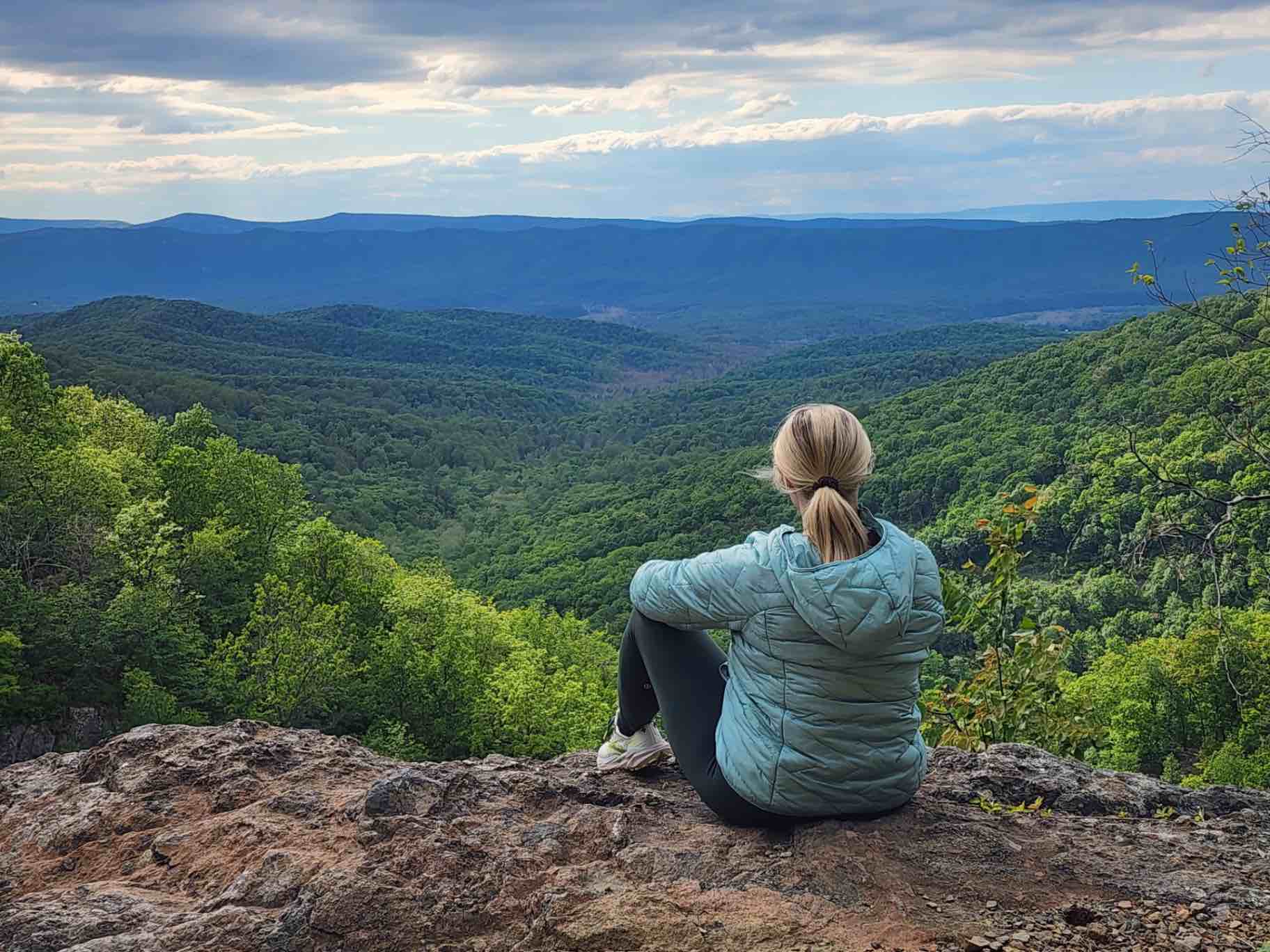
I might be biased because Shenandoah National Park is in our home state of Virginia and only a couple of hours from home, but I genuinely think it’s one of the prettiest national parks on the East Coast.
And while Shenandoah may not have the dramatic scale of the Rockies, it has something else that keeps pulling us back over and over again — an old, gentle kind of beauty.
The mountains feel ancient. The forests are lush and green. The overlooks seem endless. On misty mornings, the Blue Ridge Mountains almost look painted into the distance layer by layer. It’s peaceful in a way that’s hard to explain unless you’ve experienced it yourself.
There’s something about the Blue Ridge Mountains that feels softer than the western parks we’ve visited. The Rockies make you feel tiny in an intense, dramatic kind of way. Shenandoah feels different. The mountains roll endlessly into each other, covered in layers of green that slowly fade blue in the distance.
And if you catch the park on a foggy morning? Forget it. The entire place feels like a movie scene.
We’ve driven Skyline Drive with the windows down on cool summer mornings, watched storms roll through the valleys from overlooks, and sat outside the camper while the mountains slowly disappeared into the evening haze. Shenandoah just has a peacefulness to it that’s hard to explain until you experience it yourself.
That’s exactly why we keep returning to Shenandoah National Park and why this has become one of our favorite Shenandoah National Park itinerary ideas for a long weekend adventure.

Why We Love Shenandoah National Park
One of my favorite things about Shenandoah is that you truly get to choose your own adventure.
Want to casually enjoy mountain views without sacrificing your lung capacity? Drive Skyline Drive and stop at overlooks along the way.
Want to aggressively question your fitness level halfway through a hike while eating a granola bar for emotional support? Shenandoah can provide that too.
More than 100 miles of the Appalachian Trail run through the park, and there are hikes for almost every fitness level imaginable. You can find:
- short scenic loops
- waterfall hikes
- summit hikes
- swimming holes
- rocky overlooks
- all-day treks with serious elevation gain
Personally, we think the northern end of the park is the best area to focus on for a long weekend trip. It tends to feel a little quieter, the mountains somehow feel bigger, and many of our favorite hikes are located on that side of the park.
Another huge reason we love Shenandoah? It’s one of the more dog-friendly national parks we’ve visited on the East Coast.
There are tons of trails where your adventure dog can join you, as long as they’re leashed and well behaved. Just make sure to double check trail restrictions before finalizing plans because a few hikes inside the park do prohibit dogs.
If you’re planning a trip with your dogs, we also shared some of our favorite tips in a post about what we do differently when camping in a campground.

Our 3 Day Shenandoah National Park Itinerary
If we were planning a realistic 3 day Shenandoah National Park itinerary, this is exactly how we’d do it.
Step One: Pick Your Hikes First
Before choosing a campground, we always start by planning the hikes we want to do.
Shenandoah is a surprisingly large park, and driving back and forth constantly can eat up a lot of time. Choosing your hikes first helps you figure out where your best “basecamp” location should be.
We usually use AllTrails to research hikes, but fair warning: AllTrails has a funny way of convincing you that you’re about to enjoy a peaceful little nature walk before suddenly humbling you with 2,500 feet of elevation gain.
So maybe read the reviews carefully before committing.
One of the best things about Shenandoah hiking is the variety. You can choose:
- a short overlook trail
- a waterfall hike
- a moderate summit
- or a full day challenge
Some hikes are less than half a mile while others can turn into massive all-day adventures.
And summit snacks? Summit snacks are scientifically better. I don’t make the rules. Somehow an apple after suffering uphill for two hours tastes like a Michelin star dessert.

Picking a Campground in Shenandoah National Park
One thing that surprises people is that there really isn’t a ton of dispersed camping directly near Shenandoah National Park.
Because of that, campgrounds usually end up being the easiest and most practical option, especially for a quick weekend trip.
There are four main campgrounds inside Shenandoah National Park:
- Mathews Arm
- Big Meadows
- Lewis Mountain
- Loft Mountain
Mathews Arm is a great option if you want easier access to scenic hikes on the northern end of the park.
Big Meadows is centrally located near many of the park’s highlights, although campsites can feel a little tighter and reservations go quickly.
Lewis Mountain is the smallest campground in Shenandoah, but it’s conveniently located near amenities and popular areas.
Loft Mountain is the largest campground and has some incredible mountain views, especially in the fall.
One of the biggest parts of planning a Shenandoah National Park itinerary is deciding which campground location makes the most sense for your hikes and activities.
Our biggest recommendation is to choose a campground based on the activities and hikes you care most about rather than trying to see absolutely everything in one trip.

Our Ideal 3 Day Shenandoah Itinerary
Day One: Summit Hike
Start your trip with a mountain summit hike and earn those views immediately.
There’s just something about arriving in Shenandoah, lacing up your boots, and heading straight into the mountains that makes the stress from everyday life disappear.
Day Two: Waterfall Hike
Spend day two exploring one of Shenandoah’s many waterfall hikes.
This is usually the day where our legs start reminding us that we are not professional athletes despite what we apparently believed while planning the trip.
Day Three: Skyline Drive
Use your final day to slow down and enjoy Skyline Drive.
One of the best things about Shenandoah National Park is that even if you don’t want to hike all day, you can still experience incredible scenery simply by driving through the park and stopping at overlooks along the way.
Why We Love Exploring National Parks in a Truck Camper
Taking our truck camper to Shenandoah National Park is honestly one of our favorite ways to travel.
Having the camper with us means we can move throughout the park while still bringing all of our gear, food, and dogs along for the adventure.
And after a brutally steep hike when I’m seconds away from passing out from “lack of nutrition,” I can simply climb back into the camper and make a sandwich instead of sitting in a crowded parking lot eating stale trail mix.
That flexibility is one of our favorite parts of exploring national parks in a truck camper.
Another reason we love traveling this way is because it allows us to cover a lot more ground without feeling tied to a tiny radius around one campground.
This doesn’t totally apply to Shenandoah since there aren’t a huge number of dispersed camping options directly around the park, but as you start traveling farther west, having a truck camper or rooftop tent opens the door to some really incredible places that larger rigs simply can’t access.
That flexibility has completely changed the way we explore national parks.
If you are heading out on a boon docking trip, here are some tips on how we power our truck camper when we are off-grid.
And if you’re wondering what our must have truck camper essentials are, I cover them in this post.
Hiking Shenandoah National Park With Dogs
One of the reasons Shenandoah National Park stands out so much to us is how dog friendly it is compared to many other national parks.
There are more than 500 miles of dog friendly trails throughout the park, which means your adventure pup can join you on a huge number of hikes and overlooks.
There are a handful of trails where dogs are prohibited, including Old Rag and Dark Hollow Falls, but honestly… if you’re able to safely leave your pups behind for a few hours, both are worth experiencing.
Most of the trails in Shenandoah feel a little more forgiving than some of the western parks we’ve visited. They’re generally well maintained, and while the elevation gain can absolutely humble you, many hikes still feel approachable for average hikers and adventure dogs alike.
And while there are black bears in Shenandoah and you should absolutely stay aware and prepared for wildlife encounters, there is something comforting about not having to constantly wonder if a grizzly bear is about to emerge from the woods and ruin your entire afternoon.

Jingle vs. Gravity
One of my favorite memories from Shenandoah involved one of our dogs, Jingle, proving once again that he has absolutely no concept of self preservation.
We were doing a moderate hike that was manageable for the dogs, and like usual, Jingle hiked uphill with us before eventually riding in his backpack on the way down. At the time we were testing dog backpacks, and the one we were using had a very large open viewing window.
Apparently Jingle interpreted this as an invitation to launch himself directly out of the backpack while it was still attached to Chris… who is 6’2” by the way.
For one horrifying second, Jingle was dangling midair by his harness while I actively hyperventilated thinking about what could have happened.
So let this be your public service announcement:
if your dog is riding in a backpack or carrier, ALWAYS attach the safety tether to their harness and not their collar.
This is the backpack that we use for Jingle now. After miles of hiking with it, I can confirm that it is the best one we’ve used… and I’ve used a lot of dog backpacks.
Jingle somehow hikes like a tiny mountain goat despite being approximately six inches tall. He bounces effortlessly across rocks larger than his entire body while Chris powers ahead with him.
Meanwhile Lulu and I are usually somewhere in the back questioning our life choices, trying to keep our lungs operational, and wondering why hiking seemed like such a fun idea in the first place.
Honestly though, that’s part of what makes Shenandoah so special to us. It’s adventurous without feeling inaccessible. Challenging without feeling impossible. And it’s one of the few national parks where we genuinely feel like the entire family gets to experience the adventure together.

Fall in Shenandoah National Park
Shenandoah is beautiful year-round, but fall is where my heart belongs.
If you catch peak leaf season at the right time, the views inside the park are absolutely breathtaking. The mountains turn into layers of orange, gold, deep red, and green stretching for miles in every direction.
It’s one of those places that makes you stop talking for a second just to take it all in.
And honestly? That’s probably why we keep coming back.
Shenandoah may not be the tallest, most dramatic, or most famous national park in the country, but there’s something timeless about it that feels comforting every single time we visit.
If you’re looking for a realistic Shenandoah National Park itinerary that combines hiking, camping, mountain views, and dog friendly adventure, this park is hard to beat.
For us, it’s the perfect mix of mountain views, hiking, camping, peaceful drives, and realistic adventure — especially with a truck camper and two dogs along for the ride.
Because adventure doesn’t always have to be extreme to be unforgettable.
What is your favorite National Park?